
The Return of Maneuver? What Eurosatory 2026 Reveals About the Next Phase of Land Warfare

Mike Koerner //
The war in Ukraine has fundamentally changed land warfare. FPV drones, loitering munitions and persistent aerial surveillance have created an unprecedented level of battlefield transparency and limited operative manueverability. Any movement can be detected and engaged within minutes, contributing to the static nature of the conflict.
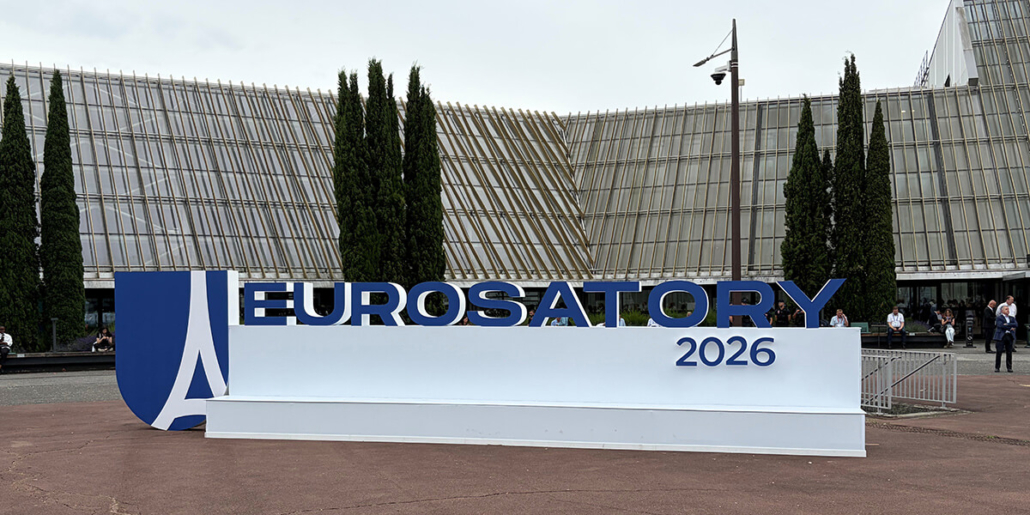
Eurosatory 2026, however, revealed a different trend. Rather than showcasing ever more capable drones, the exhibition highlighted the technologies designed to defeat them. Counter-UAS is rapidly evolving from a niche capability into a core element of future land operations.
Restoring the Balance
Across the exhibition, industry presented integrated Counter-UAS solutions combining electronic warfare, AI-enabled sensors, low-cost interceptors and directed-energy weapons. The message was clear: the technological balance is beginning to shift.
Military history suggests that this is a familiar pattern. Disruptive technologies initially provide a decisive advantage until effective countermeasures emerge. Machine guns did not permanently end maneuver warfare, and drones are unlikely to do so either.
As Lieutenant General (Ret.) Eric Wesley observed: “Drones are not the future of war. They are the problem to be solved.” Drones provide reconnaissance and precision strike, but they cannot seize or hold terrain. Future land operations will still depend on forces capable of maneuvering and controlling the battlefield.
The Next Phase
Eurosatory also demonstrated that Unmanned Ground Vehicles (UGVs) are becoming operational capabilities rather than experimental platforms. Supporting logistics, casualty evacuation and combat operations, they will increasingly complement manned forces.
Combined with UAVs, they enable Manned-Unmanned Teaming, integrating reconnaissance, logistics and combat effects into a connected operational system. If Counter-UAS capabilities can reduce the threat from the air, these technologies could restore operational tempo and maneuver.
Innovation Never Stops
At the same time, the next challenge is already emerging. Autonomous swarms and saturation attacks will seek to overwhelm sensors and defensive systems through mass rather than sophistication.
Success will therefore depend less on individual platforms than on the ability to integrate sensors, electronic warfare, air defense and autonomous systems into a resilient system of systems.
Conclusion
Eurosatory 2026 suggests that the dominance of drones may represent a temporary technological imbalance rather than the final stage of land warfare.
Powerful Counter-UAS capabilities, operational UGVs and effective Manned-Unmanned Teaming could help restore freedom of maneuver while enabling a new generation of highly connected land operations.
For armed forces, the decisive competition will not be about individual technologies. It will be about how quickly emerging technologies are transformed into operational capabilities, doctrine, training and force structures. That may be the most important lesson from Eurosatory 2026.
References
- Wesley, E.; Riggs, L.: Drones Are Not the Future of War. They Are the Problem to Be Solved. Modern War Institute at West Point, 2025.
- Author’s observations and discussions during Eurosatory 2026.
